Conversion Charts for Baking
Baking is chemistry, and small measuring errors show up in the result. These conversion charts cover the conversions bakers reach for most: cups to grams for common ingredients, oven temperatures including fan ovens and gas marks, spoon and liquid measures, and how to swap one baking pan size for another. Print them for the inside of a cupboard door.
- Instant download
- Editable Excel
- Print-ready PDF
- 7-day refund
6 files · PDF, XLSX
Baking Conversion Chart Pack
Printable baking conversion charts: cups to grams, oven temperatures, spoons and liquids, butter and eggs, pan substitutions, a fridge card and an Excel recipe scaling sheet.
- Cups to grams (PDF/XLSX)
- Oven temperatures (PDF)
- Spoons and liquids (PDF)
- + 3 more
$5.00 USD, one-time 6 files · about $0.83 each
- Instant download
- 7-day refund
- Secure checkout by Stripe
7-day money-back guarantee. Full refund within 7 days of purchase, even after you download.
Free sample: Cups to Grams Chart (PDF, 103 KB)
Baking Conversion Chart Pack
Printable baking conversion charts: cups to grams, oven temperatures, spoons and liquids, butter and eggs, pan substitutions, a fridge card and an Excel recipe scaling sheet.
- Cups to grams (PDF/XLSX)
- Oven temperatures (PDF)
- Spoons and liquids (PDF)
- Pan substitutions (PDF)
- Fridge card (PDF)
- Recipe scaler (XLSX)
Formats: PDF, XLSX. Instant download after payment (link valid 72 hours, up to 5 downloads). AI-assisted: the templates were drafted with AI help and reviewed and laid out before publishing.
$5.00 USD, one-time 6 files · about $0.83 each
- Instant download
- 7-day refund
- Secure checkout by Stripe
7-day money-back guarantee. Full refund within 7 days of purchase, even after you download.
Free sample: Cups to Grams Chart (PDF, 103 KB)
Full refund within 7 days — see the refund policy and license.
Free printables
Single sheets you can print right now, no sign-up. The full pack adds every sheet in one download plus the editable files.
 Printable Cups to Grams Baking Chart1 page · free PDF
 Printable Oven Temperature Conversion Chart1 page · free PDF
 Printable Spoons and Liquid Chart1 page · free PDF
 Printable Baking Pan Substitutions Chart1 page · free PDF
 Printable Baking Conversion Chart1 page · free PDF
 Printable Recipe Scaling Sheet1 page · free PDF
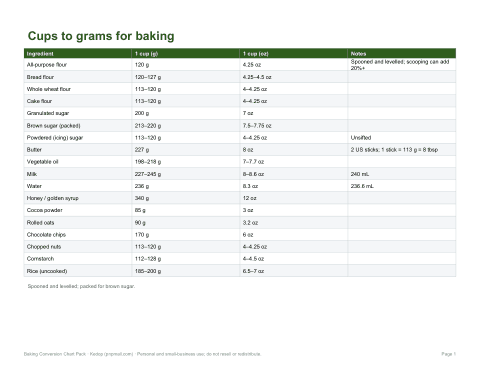
Cups to grams: common ingredients
| Ingredient | 1 US cup (g) | 1 US cup (oz) | Notes |
|---|---|---|---|
| All-purpose flour | 120 g | 4.25 oz | Spooned and levelled; scooping can add 20%+ |
| Bread flour | 120–127 g | 4.25–4.5 oz | |
| Whole wheat flour | 113–120 g | 4–4.25 oz | |
| Cake flour | 113–120 g | 4–4.25 oz | |
| Granulated sugar | 200 g | 7 oz | |
| Brown sugar (packed) | 213–220 g | 7.5–7.75 oz | |
| Powdered (icing) sugar | 113–120 g | 4–4.25 oz | Unsifted |
| Butter | 227 g | 8 oz | 2 US sticks; 1 stick = 113 g = 8 tbsp |
| Vegetable oil | 198–218 g | 7–7.7 oz | |
| Milk | 227–245 g | 8–8.6 oz | 240 mL |
| Water | 236 g | 8.3 oz | 236.6 mL |
| Honey / golden syrup | 340 g | 12 oz | |
| Cocoa powder | 85 g | 3 oz | |
| Rolled oats | 90 g | 3.2 oz | |
| Chocolate chips | 170 g | 6 oz | |
| Chopped nuts | 113–120 g | 4–4.25 oz | |
| Cornstarch | 112–128 g | 4–4.5 oz | |
| Rice (uncooked) | 185–200 g | 6.5–7 oz |
Weights vary with how the cup is filled. The figures assume flour is spooned into the cup and levelled, and brown sugar is packed. Sources differ slightly — one well-known baking company lists all-purpose flour at 120 g per cup, while others use 125 g or even 130 g — so when a recipe gives weights, use those.
Why weighing is more accurate
A cup of flour scooped straight from the bag can weigh 150 g or more, while a spooned and levelled cup is about 120 g — a 25% difference that can turn a tender cake into a dry one. A digital kitchen scale removes the guesswork, is faster (no cups to wash) and makes scaling recipes simple. If you do use cups, fluff the flour, spoon it into the cup and level it with a straight edge.
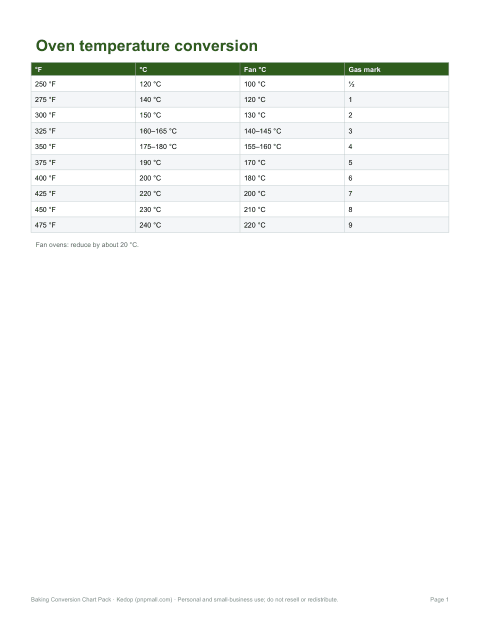
Oven temperatures
| Fahrenheit | Celsius | Fan / convection (°C) | Gas mark |
|---|---|---|---|
| 250 °F | 120 °C | 100 °C | ½ |
| 275 °F | 140 °C | 120 °C | 1 |
| 300 °F | 150 °C | 130 °C | 2 |
| 325 °F | 160–165 °C | 140–145 °C | 3 |
| 350 °F | 175–180 °C | 155–160 °C | 4 |
| 375 °F | 190 °C | 170 °C | 5 |
| 400 °F | 200 °C | 180 °C | 6 |
| 425 °F | 220 °C | 200 °C | 7 |
| 450 °F | 230 °C | 210 °C | 8 |
| 475 °F | 240 °C | 220 °C | 9 |
Fan (convection) ovens circulate hot air and cook faster, so recipes written for conventional ovens are usually reduced by about 20 °C (25 °F) for fan ovens. Many ovens run hotter or cooler than their dial says — an inexpensive oven thermometer shows the real temperature.
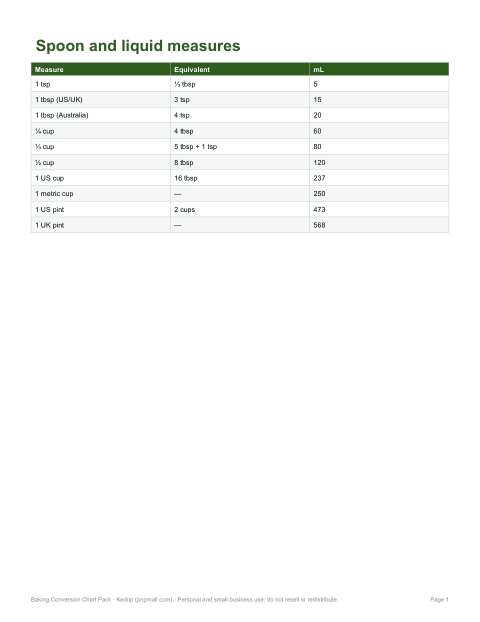
Spoons and liquid measures
| US measure | Equivalent | Metric |
|---|---|---|
| 1 teaspoon (tsp) | ⅓ tablespoon | 4.9 mL (5 mL) |
| 1 tablespoon (tbsp) | 3 teaspoons | 14.8 mL (15 mL) |
| ⅛ cup | 2 tablespoons | 29.6 mL (30 mL) |
| ¼ cup | 4 tablespoons | 59 mL (60 mL) |
| ⅓ cup | 5 tbsp + 1 tsp | 79 mL (80 mL) |
| ½ cup | 8 tablespoons | 118 mL (120 mL) |
| 1 cup | 16 tablespoons / 8 fl oz | 236.6 mL (240 mL) |
| 1 pint | 2 cups | 473 mL |
| 1 quart | 4 cups | 946 mL |
| 1 gallon | 16 cups | 3.785 L |
Cups differ around the world: a metric cup in Australia, New Zealand and Canada is 250 mL, a US customary cup is about 237 mL, and a US “legal” cup used on nutrition labels is 240 mL. An Australian tablespoon is 20 mL (four teaspoons) rather than 15 mL. A UK pint is 568 mL, larger than the US pint.
Butter conversions
| US | Grams | Tablespoons |
|---|---|---|
| 1 tablespoon | 14 g | 1 |
| ¼ cup / ½ stick | 57 g | 4 |
| ½ cup / 1 stick | 113 g | 8 |
| 1 cup / 2 sticks | 227 g | 16 |
| 1 lb / 4 sticks | 454 g | 32 |
In many countries butter is sold in 250 g blocks. A US stick is 113 g, just under half a 250 g block.
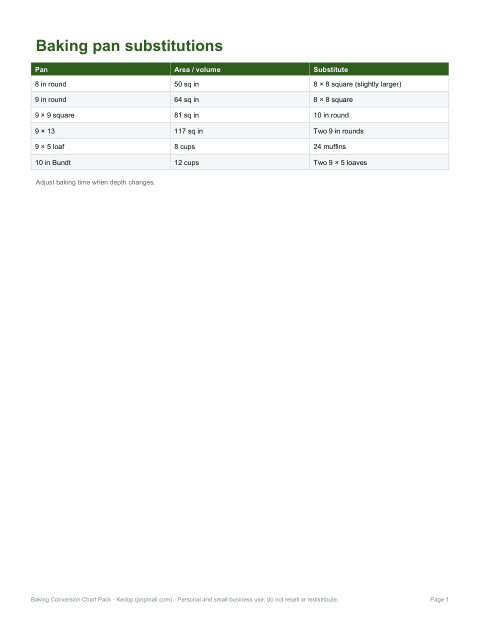
Baking pan substitutions
| Pan | Area / volume | Can substitute |
|---|---|---|
| 8 in round | 50 sq in | 8 × 8 in square (64 sq in) is slightly larger |
| 9 in round | 64 sq in | 8 × 8 in square |
| 9 × 9 in square | 81 sq in | 10 in round (79 sq in) |
| 9 × 13 in rectangle | 117 sq in | Two 9 in rounds (128 sq in), or two 8 × 8 squares |
| 9 × 5 in loaf | about 8 cups | About 24 muffins |
| 8½ × 4½ in loaf | about 6 cups | About 18 muffins |
| 10 in Bundt | about 12 cups | Two 9 × 5 loaf pans |
| 12-cup muffin tin | about ½ cup batter each | — |
When the area changes, batter depth changes and so does baking time: a shallower layer bakes faster, a deeper one slower and may need a slightly lower temperature. Fill pans no more than two-thirds full and start checking for doneness early.
Worked example
A British recipe calls for 225 g plain flour, 200 g caster sugar and baking at 180 °C (fan 160 °C). In US cups that is about 1¾ cups plus 2 tablespoons of all-purpose flour (225 ÷ 120 = 1.9 cups) and 1 cup of granulated sugar; bake at 350 °F in a conventional oven, or about 325 °F with convection. Weighing with a scale set to grams avoids the conversion altogether.
What’s in the pack
- Cups-to-grams chart for 18 common ingredients
- Oven temperature chart with fan and gas mark
- Spoon, cup and liquid measure chart (US, metric, UK, Australian)
- Butter and egg size conversions
- Baking pan substitution chart
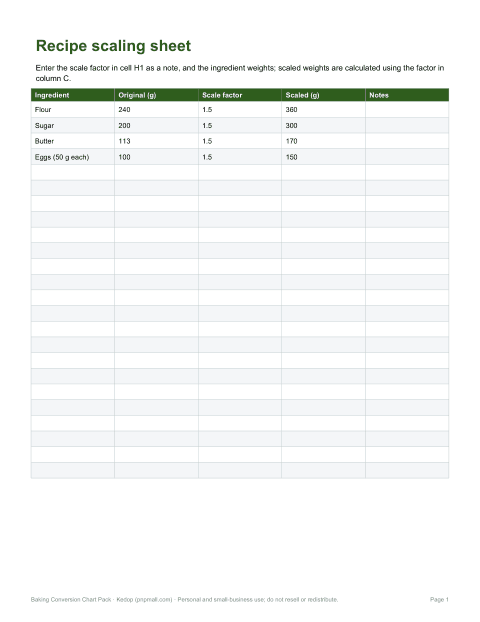
- Recipe scaling worksheet (XLSX) that multiplies ingredient weights automatically
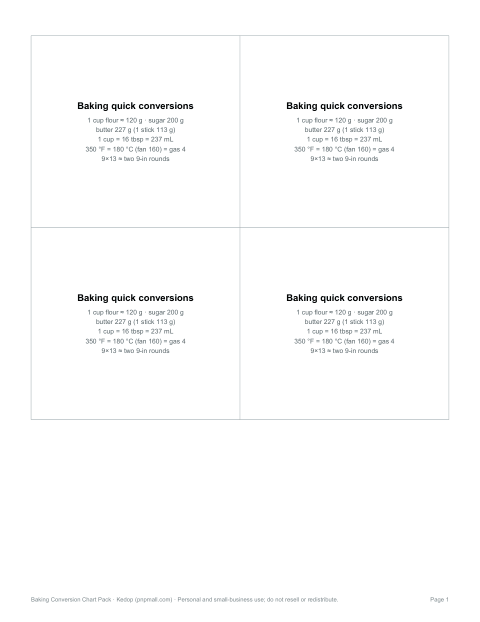
Charts print on US Letter and A4, and a small magnet-size card version fits on the fridge.
Frequently asked questions
How many grams is a cup of flour?
About 120 g for spooned and levelled all-purpose flour; scooped flour can be heavier.
What is 350 °F in Celsius?
About 175–180 °C, or 155–160 °C in a fan oven, gas mark 4.
How many tablespoons in a cup?
16 US tablespoons.
How many grams in a stick of butter?
About 113 g.
Can I use a 9×13 pan instead of two 9-inch rounds?
Yes — the area is similar (117 vs 128 sq in); adjust baking time.
Is this a subscription?
No, it is a one-time download.